Treaty

Grassroots Aboriginal movement in NSW squashes 'Recognise'

Body
Proclamation - Sovereignty - Recognise

Grassroots Aboriginal people from New South Wales have rejected recognition in the Australian Constitution in favour of Aboriginal Sovereignty, the need for Treaties and for government to enter discussions with First Nations. According to Ghillar, Michael Anderson, the Australian Government is in a quandary over the legality of its sovereignty over Australia. Aboriginal people, on the other hand, are finding it very difficult 'to get out from under' the weight of government oppression which he likened to a German 'Reich' or regime.

Time for First Nations and Peoples to pick up the pace for 'Decolonisation'

Body
Take off the Shackles

It is time to pick up the pace for decolonisation for First Nations Peoples in Australia. We need to break away from Australia's constant lies and deceit in respect to their illegitimacy in this country. ... Our London preparatory meeting is to establish an international framework that will be spread far and wide for those First Nations Peoples who have been impacted upon by the British imperialist expansion from 14th century onwards. "It is time to pick up the pace for decolonisation for First Nations Peoples in Australia. We need to break away from Australia's constant lies and deceit in respect to their illegitimacy in this country."

Overview of Treaty, Treaties, UDIs and Recognise

Body

Australia does not have its own sovereignty. Under its British constitution all governments in Australia are caretakers in occupation and govern for the non-Aboriginal people who call themselves Australians. In point of fact Federal, State and Territory governments govern in right of the Crown of Britain. These are some of the issues that must be negotiated and settled if we are truly to unite on this island continent through Treaty/Treaties and decolonisation, and/or by way of Unilateral Declarations of Independence (UDIs).

New Zealand’s Indigenous reconciliation efforts show having a treaty isn’t enough

Body
NZ Treaty

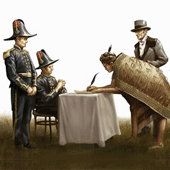
The relationship between Maori and the British Crown (which delegated its authority to the New Zealand government) has historically been filled with broken promises. Maori reached their nadir at the turn of the 20th century when their population had fallen to half of what it was at first contact - According to Senior Researcher in Maori Studies, Massey University, New Zealand. Ever since the 1840 signing of the Treaty of Waitangi, a raft of government initiatives have resulted in Maori losing both resources and power.

'Gathering of Nations' 2015 - Video Set

Body
Go to Videos

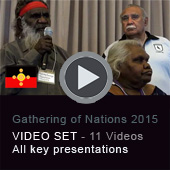
The 2015 Gathering of Nations included delegates from various Nations and observers from all over Australia. Here we have a complete set of videos of principal presentations. Topics include Updates for asserting sovereignty and the current political climate, Decolonising the Mind, Con of Constitutional reform, Rebuilding Nations, Unilateral Declarations of Independance (UDIs), Treaties and Nations, Unity through Tjukurpa Law, Citizenship and nationalities, Putting Aboriginal Law on Top, Strong Law and Culture, Want of Jurisdiction and the Spirit that connects us to country.

First Nations Treaty(ies), Sovereignty and an Australian Republic

Body
Former PM Paul Keating

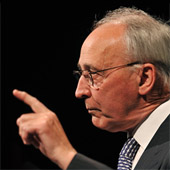
Former PM Paul Keating's foray back into Aboriginal politics where he talks up the need for a Treaty with Aboriginal and Torres Strait Islanders and describes it as the 'unfinished business of the nation' is pleasing to the ears of some of us older fighters who sees the Recognition campaign as trap. It is interesting that Prof Patrick Dodson clearly has lost his way in the political melee and finds himself in a quagmire of confusion and frustrations, when he 'argued that constitutional recognition should come first' (before a Treaty).

SU Gathering of Nations 2015 - Canberra

Body

The topics discussed at the Annual Sovereign Union 2015 Gathering at Old Parliament House in Canberra on the 21st and 22nd November will include:- Unilateral Declarations of Independence (UDIs); Strategies and methodologies for self governance; Problem Identification and Solutions; Identifying relevant UN resolutions and covenants; Defining sovereignty and understanding Treaties between Nations; Combating the deliberate destruction of our cultural heritage; Decolonisation; Citizenships; Sharing the information - Media and education strategies; The Con in Constitutional Recognition. 

Why the Deafening Silence: on Constitutional Recognition?

Body
Vote no to Constitutional Recognition

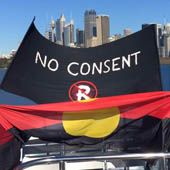
They are ramping up the 'R' campaign amongst our people at the grassroots. We need to tell the Australian public that we don't accept inequality; we don't want the government to make laws for us; the only thing we want is our sovereignty recognised, our Law and culture recognised; and by having each Nation map their own country and then negotiating their own Treaty packages will we be able to gain a type of satisfaction in this war of attrition against the colonialists. It is so wrong for non-Aboriginal people to be making choices and setting time frames for our Peoples.

Decolonisation: to be or not to be included in the Constitution?

Body
Constitution Recognition

A discussion paper Decolonisation: To be or not to be included in the Constitution puts in perspective the issue of where we choose to place ourselves as First Nations and Peoples within or outside the Australian Constitution. When the Sovereign Union argues that we have never ceded nor acquiesced our pre-existing and inherent sovereign rights, we find that the Recognise campaign is promoting acquiescence and consenting to be ruled by the colonising power from Britain, the Crown. This will be the case if there is no statement in writing to the contrary of clear and plain intent in the proposed wording of the referendum.

About Sovereign Union and our Organisational Structure

Body

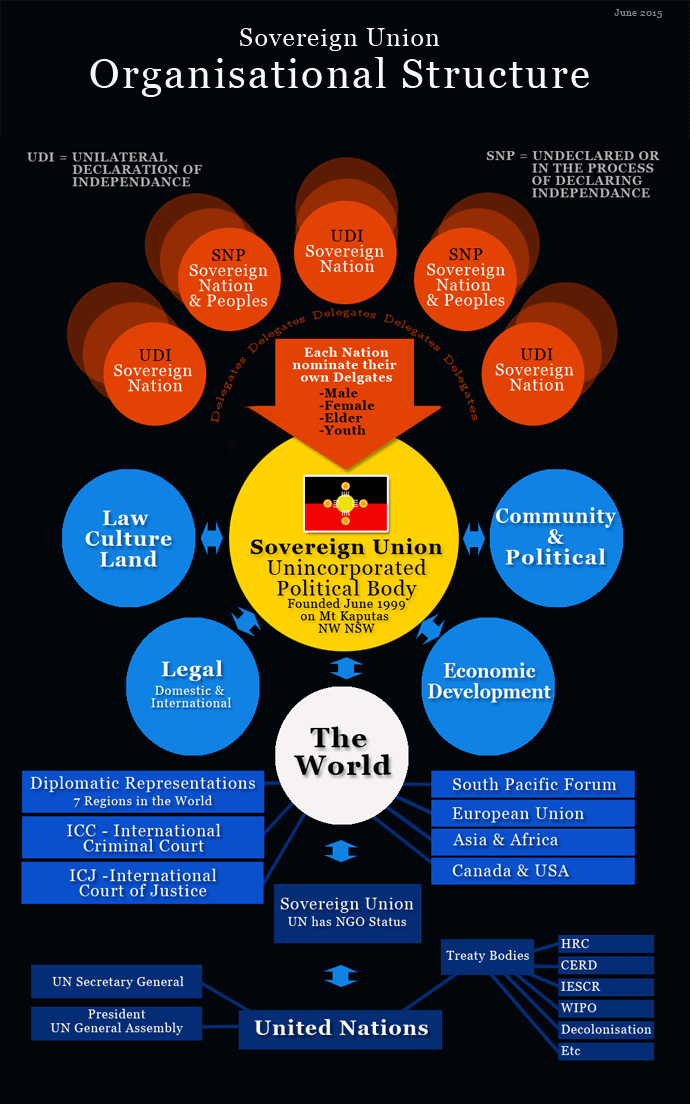
As First Nations Peoples it is now imperative that we unite and rebuild as sovereign independent nations, in order to assert our sovereign title and rights. This will be a major political and legal fight, but it is our future for not just us, but for our children and our grandchildren. The Sovereign Union governance is made up of nominated representatives from each Nation that has made their Unilateral Declaration of Independence. These representatives come together once a year to discuss all relevant political, legal, cultural, economic and social issues that confront them.