Massacres

Blood on the Wattle - Book Review

Body

A book by Bruce Elder which has become widely used in teaching Aboriginal history at both secondary and tertiary levels. Bruce's account of the atrocities committed as white settlers pushed into the rich grazing lands is handled with a journalistic objectivity. One gruesome event at Myall Creek, Elder skillfully juxtaposes the harmonious relationships between the Aboriginal people and the farmhands, with a renegade gang determined to seek retribution on any Aboriginal people that happen to cross their path.

The 'Recognition Campaign' and the gaping hole in Australian history education

Body

Educating for Democracy - A letter by Ray Jackson, President, Indigenous Social Justice Association.

Ray reminds us of the hypocrisy in relation to the 'Recognition Campaign' after 227 years of silence, and at the same time in our education system, choosing not to recognise that the First Nations and peoples even existed or that each nation fought a bloody battle for the land and their rights.

Survivors of 'forgotten' Woolwonga tribe acknowledged 130 years after 'extermination'

Body
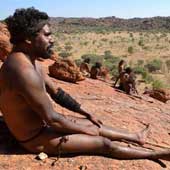
The man identified only as Long Peter

The Woolwonga were said to have been exterminated in 1884 at Burrundie about 200 kilometres south of Darwin in reprisal for spearing non-Aboriginal miners.

But about four years ago an 1899 census document was found showing at least one had survived. Exactly how the girl known as Jennie survived the massacre of her people - the Woolwonga of the Alligator River near Katherine - is not known.

Smoking ceremony held at controversial explorer statue

Body

Around 80 people attended a rally in Alice Springs calling for the removal of a four metre high statue of explorer John McDouall Stuart, the first European to traverse the continent from south to north in 1862.
A letter was also distributed, written by the elders directly to John McDouall Stuart, accusing him of not asking permission to enter the land and of killing Arrernte people. "You came to Mount Hay and you killed our mob," it stated.

Remains of Robbins Island First Nations girl Naungarrika arives home after 200 years

Body

Around 30 First Nations men, women and children were killed and thrown from cliffs in 1828, in one the many British invaders mass murdering sprees. This is known as the Cape Grim massacre. The remains of one of the victims was a young girl named Naungarrika, who finally arrived back to her home state of Tasmania after 200 years of humiliation as a scientific and curiosity trophy.

The First Nations community will decide how to belatedly farewell Nungarrika, but it is likely to be in her own country.

War Memorial should recognise the Frontier Wars: Researcher

Body

A researcher, who presented alarming numbers of the deaths in Queenslands Frontier Wars between 1788 and 1930 to the Australian Historical Association, said the estimated figure of 65,180 was "conservative" and could be as high as 115,000. A co-author of the report, historian Professor Raymond Evans, said the calculations were based on official records, witnesses' reports and the number of patrols undertaken by the colonial Queensland government's Native Police. - Pictured: Historian Professor Raymond Evans

The nuclear wars waged against First Nations people

Body

The British have waged undeclared wars on First Nations peoples ever since 1788.

The murder and misery inflicted today reminds us of when settlers rode into communities on horse back and cut down extended families. In current times, the government does not only allow multi-national mining giants to rape the country and destroy ancient cultures, but they are trying to force First Nations people to live with the poisonous waste.

Gallipoli to Coniston - Remembering Frontiers - Seminar and Art Exhibition - Sydney

Body

Two days of looking at the subject of war and who fought in those wars, and including the why. Very importantly several sessions will be dedicated to the frontier wars in the 'unsettling' of the invasion of the traditional nations of this country, Australia. - Thursday 28th and Friday 29th August 2014, Level 3, Mary Ann House,
645 Harris Street, University Technology Sydney
Image: A still from the documentary 'Coniston'

Why the number of deaths in the Frontier Wars do matter

Body

Some researchers have said that there was 10 First Nations people death for each European killed in the process of the British Invasion. However research is now telling us that is was probably 40 to 1.

There are stories of massacres everywhere in the archives of the major cultural institutions of Australia and Great Britain. They are in the diaries, letters, journals and memoirs of colonial and postcolonial officials, troops, police, farmers, frontiersmen and women.