Frontier Wars

Blood on the Wattle - Book Review

Body

A book by Bruce Elder which has become widely used in teaching Aboriginal history at both secondary and tertiary levels. Bruce's account of the atrocities committed as white settlers pushed into the rich grazing lands is handled with a journalistic objectivity. One gruesome event at Myall Creek, Elder skillfully juxtaposes the harmonious relationships between the Aboriginal people and the farmhands, with a renegade gang determined to seek retribution on any Aboriginal people that happen to cross their path.

Sound files of the Frontier Wars - The First Nations fight back

Body

In his new book, The Story of Australia's People, Geoffrey Blainey writes that one of the reasons aboriginal tribes didn’t effectively resist European settlement was that they were militarily weak. Indigenous tribes often fought with each other rather than launch coordinated attacks against settlers. An alternative view comes from expert in indigenous history, Dr Ray Kerkhove, who has done new research on indigenous warfare in Queensland in the 19th century.

The 'Recognition Campaign' and the gaping hole in Australian history education

Body

Educating for Democracy - A letter by Ray Jackson, President, Indigenous Social Justice Association.

Ray reminds us of the hypocrisy in relation to the 'Recognition Campaign' after 227 years of silence, and at the same time in our education system, choosing not to recognise that the First Nations and peoples even existed or that each nation fought a bloody battle for the land and their rights.

Survivors of 'forgotten' Woolwonga tribe acknowledged 130 years after 'extermination'

Body
The man identified only as Long Peter

The Woolwonga were said to have been exterminated in 1884 at Burrundie about 200 kilometres south of Darwin in reprisal for spearing non-Aboriginal miners.

But about four years ago an 1899 census document was found showing at least one had survived. Exactly how the girl known as Jennie survived the massacre of her people - the Woolwonga of the Alligator River near Katherine - is not known.

Smoking ceremony held at controversial explorer statue

Body

Around 80 people attended a rally in Alice Springs calling for the removal of a four metre high statue of explorer John McDouall Stuart, the first European to traverse the continent from south to north in 1862.
A letter was also distributed, written by the elders directly to John McDouall Stuart, accusing him of not asking permission to enter the land and of killing Arrernte people. "You came to Mount Hay and you killed our mob," it stated.

'A Coloured History' with Bruce Pascoe and Henry Reynolds

Body
Big Ideas Video

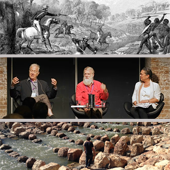
Do yourself a favour and watch this unreal video of historians Henry Reynolds and Bruce Pascoe speaking at the Sydney Writers Festival.

They speak on wars, memorials, the lack of commemorations, agriculture and the mainstream denial of the rich history of one of the world's great continents ... and the world's first bakers, with more than 12,000 years experience baking bread before any other country in the world. - ABC News 24 - 'Big Ideas'.

19th century tintype portrait of a young Aboriginal woman from Tasmania found

Body

A rare and haunting image of a young, unidentified Indigenous woman has been donated to the Australian Institute of Aboriginal and Torres Strait Islander Studies (AIATSIS) after being discovered by a family living in the United Kingdom.

The tiny tintype photograph, measuring about 2 centimetres by 3cm, is the only one of its kind to be held by AIATSIS and is believed to be the oldest in its 650,000-strong photographic collection.

Australia: NAIDOC glorifies Aboriginal involvement in World War I

Body

When it comes to First Nations people, the government never does anything without having a very devious agenda. So following 100 years of a deplorable lack of respect and disregard for First Nations soldiers, then there is suddenly recognition, beware.

The intensive propaganda campaign is designed to whitewash the real nature of WWI, drown out opposition to war and boost military enlistments.

Remains of Robbins Island First Nations girl Naungarrika arives home after 200 years

Body

Around 30 First Nations men, women and children were killed and thrown from cliffs in 1828, in one the many British invaders mass murdering sprees. This is known as the Cape Grim massacre. The remains of one of the victims was a young girl named Naungarrika, who finally arrived back to her home state of Tasmania after 200 years of humiliation as a scientific and curiosity trophy.

The First Nations community will decide how to belatedly farewell Nungarrika, but it is likely to be in her own country.

Statue of White man holding a gun installed in Alice Springs

Body

An explorer who had at least two conflicts with First Nations people in the nineteenth century was commemorated with a statue of him holding a gun on a Masonic symbol platform right in the centre of Alice Springs

The statue is of John McDouall Stuart, a Scottish explorer who had at least two conflicts with First Nations people during his explorations moving northerly from Adelaide, in the 19th Century.