The Freedom Fighters - Tunnerminnerwait, Maulboyheenner and Truganini
Body
 Freedom Fighters Commemoration


Freedom Fighters Commemoration
The British have waged undeclared wars on First Nations peoples ever since 1788.
The murder and misery inflicted today reminds us of when settlers rode into communities on horse back and cut down extended families. In current times, the government does not only allow multi-national mining giants to rape the country and destroy ancient cultures, but they are trying to force First Nations people to live with the poisonous waste.
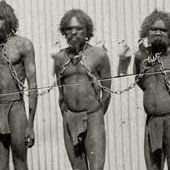
Chain gangs and slave labour in Australia" width="690" height="300" border="0">
Notice the tin mugs placed in strategic places on the tin wall behind the prisoners - if one wanted a drink or go to the toilet the whole gang would have to go with them. In some cases, people were chained next to a member of a tribal group that is culturally inappropriate to even to speak to, never-loan the different customs and language barriers. It's no wonder they had difficulty fitting into their own family group when they were 'lucky' enough to return to their home.
This page provides an insight into the treatment of the First Nations peoples in the second phase of the mass slaughters in the Australian Eastern states and the archaic attitudes of the colonisers immediately following the first stage of the invasion and the many massacres, land theft and displacements in the late 18th to the mid 19th centuries.
Chain gangs and slave labour in Australia" width="690" height="300" border="0">
Notice the tin mug placed in strategic places on the tin wall behind the prisoners - if one wanted a drink or go to the toilet the whole gang would have to go with them. In some cases, people were chained next to a member of a tribal group that is culturally inappropriate to even to speak to, never-loan the different customs and language barriers. It's no wonder they had difficulty fitting into their own family group when they were 'lucky' enough to return to their home.
Signalling hills and lookouts were of immense importance for Aboriginal groups. They were often pivotal landmarks in the Songlines landscape, major means of communication and education, and tools for co-ordinated hunting or fishing. Their importance is reflected in some Aboriginal place names, for instance Nildottie in South Australia, which actually meant "smoke signal hill."
Aboriginal signalling lookouts are of interest for the role they seem to have played in co-ordinating resistance activities.
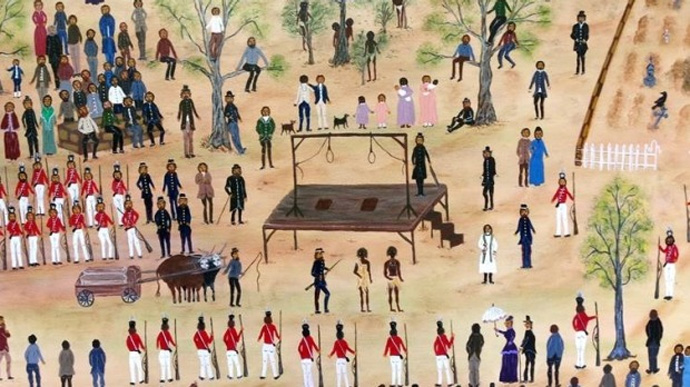
Clare Rawlinson ABC 27 November 2015
A swing set reminiscent of the gallows where two Indigenous men were hanged in 1842 will be erected as a memorial to colonial conflict in Melbourne.

A police officer involved in a confrontation with a journalist from the national Indigenous broadcaster on Anzac Day breached the AFP's Code of Conduct, an inquiry has found. NITV video journalist Myles Morgan was filming a march by Indigenous and non-Indigenous people calling for recognition of Indigenous people killed during the colonisation of Australia, when the incident took place at Anzac Parade in Canberra this year. During the march, which took place behind a traditional Anzac Day parade, a scuffle broke out between protesters and members of ACT Policing, a branch of the Australian Federal Police. One officer drew his taser and gestured at one of the march leaders.
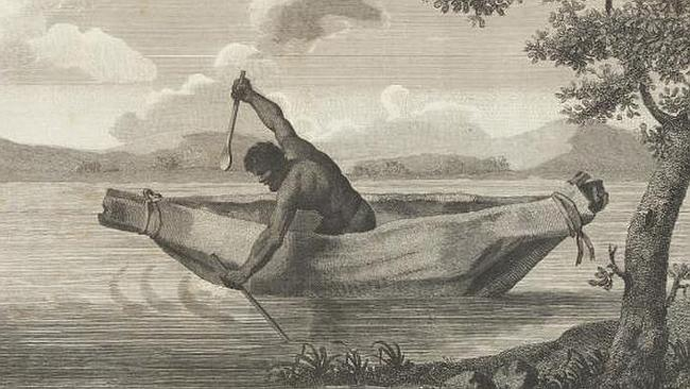
(Picture: State Library of Victoria)
news.com.au 12 September 2-15
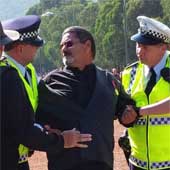
Mr Fred Hooper, Head of State of the Murrawarri Republic, who served in the Royal Australian Navy as a submariner, was prevented from marching in Canberra on ANZAC Day in commemoration of his Grandfather and his two great uncles. Mr Hooper said from Canberra. “ I wanted to march with my Navy mates, but was prevented by the Australian Federal Police. Instead I was given a police escort from the back of the parade to the front, where the Submarine Association was gathered before the official march commenced.”